The landscapes we know and return to become places of solace. We are drawn to them because of the stories they tell, because of the memories they hold, or simply because of the sheer beauty that calls us back again and again. – Terry Tempest Williams


We've come full circle. IRV is out to pasture in Kenai until next fall, having carried us 21,398 miles in 6 months. Not bad for an old rig. Took some front end work, brake work, one new windshield (now pitted due to a Colorado sandstorm), and a lot of gas and oil. IRV is in better shape than when we started. As for us, well, we know more.
Some things we have learned about the 48 states:
- The country is huge! HUGE!! Especially when observed from narrow twisty roads.
- The diversity is astounding. To appreciate it, avoid the interstates, a single monotonous landscape.
- History comes to life when its locations are experienced. Our history is intriguing and complex. Big help: National Park system, some state parks, and, of course, Interpretive Signs!
- All grocery stores are not created equal. Some regions suffer from grocery store deficit. Were they all Wegman's.
Compare and contrast:
 |
| Zabriski Point, Death Valley, California |
 |
| Douglas Fir, Lewis & Clark National Park, Washington |
 |
| Monument Valley, Navajo Nation Park, Utah |
 |
| Gail enjoying sister Carol's mustang Lucky in Alamosa, Colorado |
 |
| Scott, Ann and Gail |
After the deep pleasure of visiting family and friends in Colorado, we moved further into the Great American Southwest to Zion, where our friends the Hinckleys live when not in Alaska (luckies).
As with any of the fabulous extremes of the Southwest, Zion cannot be described. 

 |
| Slickrock is wonderful to clamber on if it's not too steep. The bighorn is not at all concerned with steepness. When it comes to steepness, the Hinckley men are much like the bighorn sheep. |
 |
| Bighorn at Zion |
Leaving Zion, we zoomed by Las Vegas (no eye contact) to get to Death Valley, which stunned us with its peculiar and surprising diversity. The driest (av. 2” rain), the lowest (minus 282 feet), the most barren, surrounded by 11,000 foot wrinkled mountains with dunes, painted hills, slot canons, dry salt seas, alluvial fans, lava flows, volcanic craters, and ancient mines. Unexpectedly wildly captivating. Bonus: lovely winter temperatures.
 |
| Death Valley's Artist's Palette. Caused by oxidization of minerals found in some lava flows. |

Craig on infinite, unforgiving salt pan, the archetypical Death Valley.

 |
| Crater rim viewed from opposite rim. |
* * * *


 Gail and brother Richard, and Craig on a trek above Goat Rock Beach near the mouth of the Russian River, Sonoma County.


 Nothing could be more different from Death Valley than the old growth rain forest of Washington's Olympic Peninsula (Olympic National Park). Two hundred inches of rain may fall each year. We camped where we were transfixed by huge storm rollers coming in from far, and considered that a rogue wave could sweep us away in the night.

Colossal trees (Douglas Fir, Red Cedar, Sitka Spruce and Western Hemlock) tower above a chaos of nurse logs, snags, sprouts and moss.

We were too soon in Bellingham but excited to catch the ferry to Haines, our first full inside passage trip.
Definitely back in Alaska, land of record snowfall, most of the worlds’ non-polar glaciers, staggering scale, etc. etc. etc. After our grand adventure, we are lucky to be returning to such a place, or we could feel let down.
"Water, water, everywhere........
In an apparent distortion of space/time, we were soon on California's Highway 1, thrilled by driving rain, big trees, fog, sea stacks and monster surf far below. We pondered how long it would have taken the '49ers to escape Death Valley and make it to the coast. A long while. Though we know the auto fools us about distance, our heads still spun from the extremes.
 |
| Northwest California coast |


 Gail and brother Richard, and Craig on a trek above Goat Rock Beach near the mouth of the Russian River, Sonoma County.
Elephant seals doing the wild thing on St. Valentine's Day, their traditional day for a big romp on the beach. They stay at sea unless they are molting, mating or birthing. The size of the male skulls dwarfs those of polar bears, brown bears, and Steller sea lions. We're talking enormous.
Gail's brother Richard lives north of San Francisco (that jewel and delight); the cousins Harvey clan are scattered around Northern California; and friends Monroe and K Robinson are near Mendocino when not at Twin Lakes in Alaska. We loved the good company, the culture, and the chance to stretch out.

The wildness and sparse population of the Northwest Coast is surprising and reassuring. Only narrow, winding roads connect California’s central valley with the north coast, and ocean access has been preserved for everyone, not just the privileged, as is often lamentable in the east.


 |
| Ancient red cedar. Note tiny Gail at bottom. |
 |
| Ancient red cedar. |
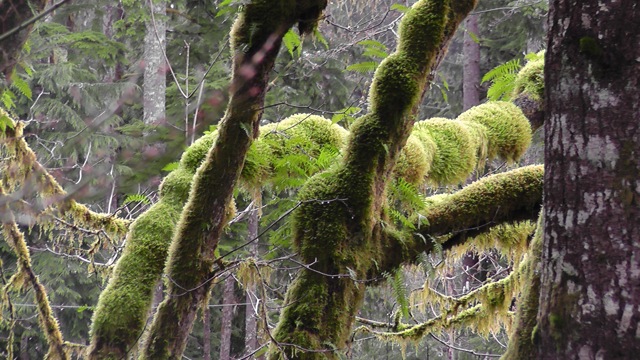
We are glad for trails (and interpretive signs). Everything drips with rain and moss.
We began to weep, as this place called up tenderness and inexpressible emotion. The wettest and the driest places each call us to return.
The juxtaposition of bald clear-cuts with patches of uni-forest is disturbing. Though we understand the need for timber and jobs, it is disheartening to see vast mountains of pulp being loaded for Asian ports. Thousands of bombed out un-reclaimed acres are the most unnerving. We feel grateful for existing preservation.
The big circle closed with our return to Vancouver BC, home of daughter Camille, Alex, toddler Gabe and twins Chloe and Claire. The little ones are bigger! We were so happy to catch up and have playtime with our grandchildren.
 |
| Gabriel |
 |
| Chloe, Claire |
 |
| Boarding the Matanuska in Bellingham, Washington |
We were too soon in Bellingham but excited to catch the ferry to Haines, our first full inside passage trip.
Of note: the maneuvering of the large vessel through the miles-long Wrangell Narrows is a dramatic ferry slalom with rocky reefs on either side.
As we headed north, the mountains reached ever higher above the endless dark coast and rare, lovely small ports. It met expectations and more.
 |
| Dodging buoys in the Wrangell Narrows |
 |
| Lynn Canal near Haines, Alaska |
 |
| The Haines Highway was drifting seriously and closed for plowing the day after we traversed it. |
Definitely back in Alaska, land of record snowfall, most of the worlds’ non-polar glaciers, staggering scale, etc. etc. etc. After our grand adventure, we are lucky to be returning to such a place, or we could feel let down.
 |
| IRV resting in driveway. Snow berm is from road clearing along Kenai Spur highway. |
Oh yes, some interesting road signs:
· Runaway Vehicles Only (Hope we won’t be needing that!)
· Do Not Enter When Flooded (Ohkaaaaaay!)
· Heavy Roadside Activity (Heavy, man. What kind of activity was that?)
Our favorite sign was on Route 20 crossing the California Coast Range. It had changed from two steep and winding, but normal, paved lanes with shoulders, to one lane without shoulders, blind hairpin curves, sheer drop-offs, and broken asphalt. With tires barely fitting on the road we read: “Road Narrows.”
Vesta the Cat enjoys the wide spaces of our gracious friends’ homes, though we think she favors the expanse of a warm southwest desert. The 4-foot snow berms in Anchorage are tough for a little cat to negotiate. Patience, kitty, we will soon be at the cabin at Lake Clark. Just one tiny detour first, to Scotland, to welcome Willow and Michael’s first baby, due in mid-April.
We haven’t found our winter home yet. In the fall, we see ourselves heading back to the Southwest for awhile. After that, dear reader, the crystal ball grows dim…….